
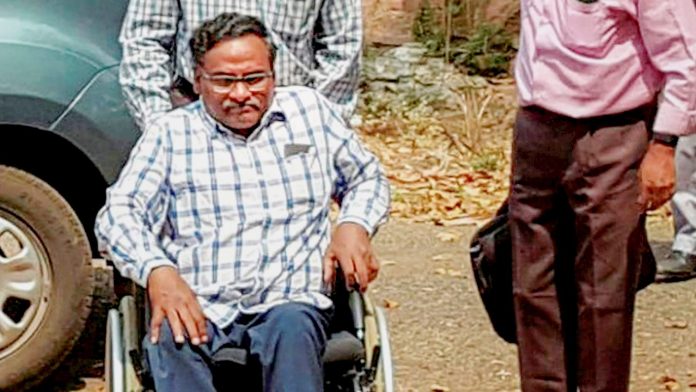
Mumbai: The Bombay High Court on Friday the former Delhi University professor GN Saibaba in a case allegedly linked with the Maoists for lack of valid sanction for prosecuting him under the Unlawful Activities (Prevention) Act (UAPA).
Immediately after his acquittal by the Bombay High Court, the National Investigation Agency (NIA), probing the case, moved the Supreme Court against the HC decision, but the apex court turned the agency’s plea seeking a stay on the HC order.
The HC set aside the life imprisonment awarded to Saibaba by a trial court, the court said that while it is necessary to fight against terrorism, procedural safeguards cannot be sacrificed “at the altar of perceived peril to national security.” The decision to acquit Saibaba came after eight years of his arrest. The 52-year-old professor is likely to be set free from Nagpur central jail where he has been lodged since May 2014. The Nagpur bench of the high court comprising Justice Rohit Deo and Anil Pansare said that sanction to prosecute the accused under the UAPA was “bad law and invalid.”
The bench said that Saibaba, who moves on a wheel-chair because of 90% of physical disability, should be freed immediately if he was not required in any other case. Saibaba’s wife As Vasantha Kumari welcomed the court ruling saying that they knew the professor would be acquitted.
When Saibaba was arrested, he was a resident of Delhi. Other accused in the case Mahesh Tirki and Pandu Narote died during the trial. They were farmers from Gadchiroli district. Besides, there was a student Hem Mishra who lived in Almorah district of Uttarakhand and Prashana Sanglikar, a journalist, who was from Dehradun. Another accused, Vijay Tirki, who was a labourer from Chhattisgarh. Meanwhile, the Left parties across the country hailed the acquittal of Saibaba.
