
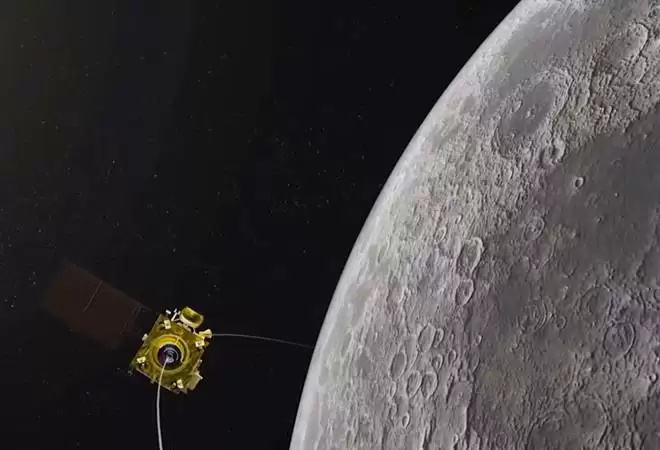
Officials announced on Monday that India’s Chandrayaan-2 spacecraft has made more than 9,000 orbits around the Moon and that the imaging and scientific equipment onboard have been delivering good data. The Indian Space Research Organisation (ISRO) is hosting a two-day Lunar Science Workshop 2021, which started on Monday, to mark the end of Chandrayaan-2’s two-year mission around the lunar orbit.
ISRO Chairman K Sivan said in his inauguration presentation that the Chandrayaan-2 spacecraft’s eight instruments are undertaking remote sensing and in-situ studies of the Moon at a distance of about 100 kilometers from the lunar surface. Data product and science documentation, data from Chandrayaan-2 orbiter payloads, were released by Sivan, according to the Bengaluru-based ISRO.
Read also: Ex-top Kerala cop Siby Mathews gets anticipatory bail in ‘new’ ISRO Spy case
Sivan stated that he studied the scientific findings and considered them to be “very promising.” A S Kiran Kumar, Chairman of ISRO’s Apex Science Board, stated that the imaging and scientific equipment onboard the Chandrayaan-2 spacecraft had provided good data.
“Many new features have been integrated into Chandrayaan-2’s equipment, which are bringing the observations made on Chandrayaan-1 to a newer and higher level,” said Kiran Kumar, a former ISRO Chairman. Vanitha M, the Chandrayaan-2 project director, stated that all of the orbiter’s subsystems were working smoothly.
The orbiter’s imaging payloads – TMC-2 (Terrain Mapping Camera-2), IIRS (Imaging IR Spectrometer), and OHRC (Orbiter High-Resolution Camera) – have delivered us breath-taking images of the Moon, according to Vanitha.
Read also; ISRO soon to carry out static test of solid fuel engine for small rocket
According to an ISRO statement, the two-day workshop is being live-streamed on the space agency’s website and Facebook page to efficiently reach students, academia, and institutes and involve the scientific community in the analysis of Chandrayaan-2 data. The scientists in a virtual workshop are presenting the research results from the eight payloads.
