
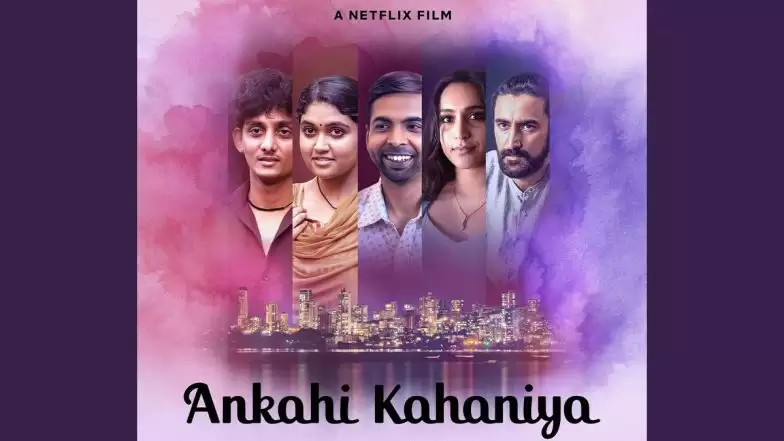

Enough film reels, newspapers, and now digital memories have been committed to recording the metro cities’ approaching “loneliness.” Mumbai has always been the hulking, ominous beast that explains our protagonist Pradeep (Abhishek Banerjee) in the first instalment of the three-part anthology Ankahi Kahaniya, which is available on Netflix.
Love. We keep returning to this elusive sensation, which has grown mythological dimensions in modern times and remains elusive for more individuals than ever. It is said to be about the overpowering need for love. It’s easy to blame it on technology, the rat race, or, more recently, the epidemic. But love has never been so out of reach for the average person in human history.
Read also: Kota Factory 2 Review: Same Food Served in a New Dish?
A simple, bashful Pradeep narrative is told in the first half, directed by Ashwini Iyer Tiwari. He’s from a hamlet in MP, and he’s caught in the daily grind of working as a salesperson at a Mumbai ready-made clothing store. While everyone around him is on a date, from his younger, slick coworker who brings his girl to Juhu beach to his basti roommate who is hooked to his phone while he loves his lady love, he is single. Pradeep falls hard for a female mannequin brought to the store to exhibit women’s clothes, and Cupid eventually takes pity on him.
With a great grin on his face, he names her Pari, brings her to the beach, and buys her gifts. When the business owner discovers camera evidence of him romancing the dummy, all hell breaks out. Pradeep has taken a lot of heat for his alleged immorality. But why is it seen as moral turpitude? Love dolls are a subculture in Japan that provides all kinds of companionship to the increasingly alone Japanese populace.
Love dolls, for someone like Pradeep, who symbolises many such young people from the Indian hinterland who are unable to cope with the sleek demands of a bustling city, may be a valuable stepping stone, giving them confidence that will aid them in real-life circumstances.
However, we may be being overly optimistic. Why can’t directors use talented performers in unexpected ways rather than typecasting them? We’re concerned that Banerjee may follow in the footsteps of Pankaj Tripathi, who has been typecast as a “Hindi hinterland figure” with his characteristic “neck motion.”
The second half is also set in Mumbai. Manjari, played by Rinky Rajguru, is confined to doing chores at home, and her only escape is going to the local cinema to see Marathi movies. When a young girl stuck in an unhappy home meets an errand boy in a decrepit single-screen theatre, love blossoms. Glances are exchanged, dates are set, ice cream is consumed, and beach walks are taken. However, nothing is said clearly.
As they attempt to escape from their current existence, the two must confront their terrible realities. The second half has far too many parallels to Sairat, the film that made Rajguru famous. Her outfit and her body language are all taken from the second half of Sairat. Director Abhishek Chaubey should have done better, but his storey is the only one that keeps to the ‘unsaid’ portion of the requirement.
The third instalment of Ankahi Kahaniyan transports us to posh, opulent Mumbai, where meetings are held at the quaint Taj Mahal Tea House, and offsites are held in beach resorts. Tanu and Manav are introduced, who have come together since their respective wives are having an affair. Two cuckolded wives attempt to retrace their lovers’ affair in a perfect homage to the cult film In the Mood for Love. I’ve been there and done that. Saket Chaudhary tries to give the storey a unique twist, but it’s too obvious, and the prose, well, lags.
Read also: Rasika Duggal’s short film ‘Kshay’ to screen at Bandra Film Fest
The anthology was meant to transport us to the less-than-glamorous realm of grief and life beyond rose-tinted spectacles. Ankahi Kahaniyan does not elicit any feeling. The conversation is highlighted, and the message is frequently conveyed in a pompous, blatant manner. The anthology would have been appropriate in the 2000s, but it will not work in 2021.
Netflix also appears to be fixated on the anthology format. Ray, Navrasa, Ajeeb Dastaans, and a slew of others have all done them recently. We’re not sure why. The whole point of streaming services was to obtain extremely detailed tales to provide an immersive storytelling experience for everyone. We recognise that ‘content’ may take many forms, but none of the anthologies has proven successful, have they? Nonetheless, they appear to have an endless supply of them. Anyway, feel free to skip the producers’ shoddy, sloppy attempt. Ankahi Kahaniyan’s stories would have been best left unsaid.
