
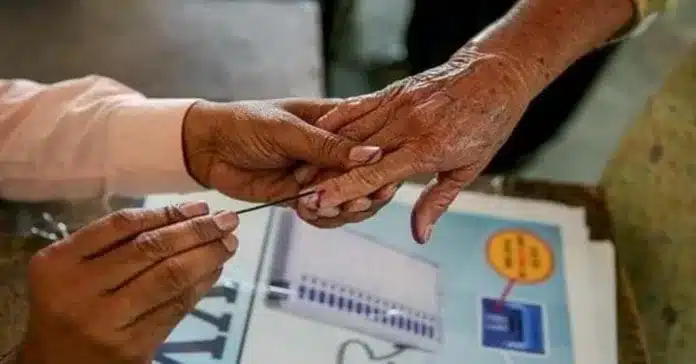
News Desk – The Supreme Court will hear an important case on November 6, 2025, involving whether voters should be allowed to express dissatisfaction using NOTA (None of the Above) even when an election is uncontested.
Two organisations Vidhi Centre for Legal Policy and Association for Democratic Reforms (ADR) have challenged Section 53(2) of the Representation of the People Act, 1951, and related rules.
These rules say that if the number of candidates equals the number of available seats, the candidate(s) should be declared elected automatically, without any voting.
The petitioners argue:
This prevents citizens from using NOTA.
Voters should have the right to register disapproval even if there is only one candidate.
In its reply, the Central government made a key distinction:
Right to Vote – Not a fundamental right; only a legal/statutory right, Gives a citizen the eligibility to vote.
Freedom of Voting – Considered part of freedom of speech and expression under Article 19(1)(a), The act of expressing choice (candidate/NOTA) at the polling booth.
The Centre said that freedom of voting only exists when a poll actually takes place. If there is no election (because there is only one candidate), then NOTA doesn’t apply.
They argued:
“NOTA is not a candidate. It cannot force an election to be conducted.”
Election Commission Agrees
The Election Commission (EC) told the court:
Treating NOTA like a candidate would require changing the law.
Uncontested elections are rare only nine times in 20 general elections since 1951.
EC said that as democracy has evolved, uncontested wins have become extremely rare.
A Supreme Court bench led by Justice Surya Kant will hear the case, even as voting continues in the Bihar elections.
