
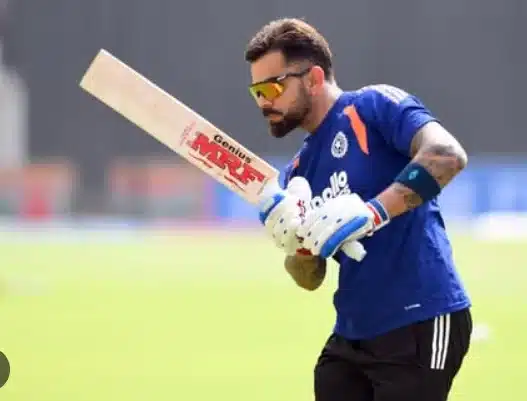
The Supreme Court has suggested involving cricketer Virat Kohli and other prominent public figures in an awareness campaign encouraging people to celebrate Diwali without firecrackers, as it examined the effectiveness of restrictions aimed at controlling air pollution in Delhi-NCR.
A bench of Justices MM Sundresh and Prasanna B Varale said authorities needed to explore new ways of changing public behaviour, observing that repeated court orders on firecrackers had often failed to produce the intended results on the ground.
The court reserved its order on firecracker restrictions in Delhi-NCR and said it would also continue monitoring their implementation.
‘Why Not Use Prominent Personalities?’
During Thursday’s hearing, Justice Varale suggested that respected sportspersons and other public figures could be used to spread awareness about the health and environmental impact of firecrackers.
Justice Sundresh specifically referred to Kohli as an example.
He suggested that celebrated cricketers could record a message asking people to enjoy the “festival of light” while reducing the use of fireworks.
The court also suggested using television, newspapers and other platforms to publicise restrictions and encourage behavioural change.
Court Says Annual Orders Have Become ‘Academic’
The bench expressed frustration over repeated violations of its directions.
It observed that every year the court issues orders aimed at reducing pollution during the festive season, but implementation remains weak.
The judges questioned what concrete enforcement action had followed earlier directions, including whether authorities had conducted inspections, seized prohibited firecrackers, registered cases or taken action against licence holders.
Justice Sundresh said court orders would have little impact unless an effective implementation mechanism operated on the ground.
Court Not Inclined Towards Complete Ban
Despite raising concerns over pollution and poor enforcement, the bench indicated that it was not inclined to impose an absolute ban on firecrackers at this stage.
The court said it understood the sentiments associated with festivals and wanted to strike a balance between celebration and public health.
However, the judges warned that continued failure to implement restrictions could force the court to adopt a stricter approach.
The bench has previously indicated that it does not favour either a blanket ban or unrestricted use of firecrackers throughout the day.
Health Risks of Firecrackers Raised in Court
During the hearing, senior advocate Aparajita Singh, appearing as amicus curiae, highlighted the health risks associated with firecracker pollution.
She told the court that firecrackers release toxic gases and hazardous particulate matter, including PM2.5, which is small enough to enter deep into the lungs and bloodstream.
She also referred to medical concerns regarding deteriorating lung health among children and non-smokers.
The submissions argued that pollution from fireworks affects not only people with respiratory illnesses but also children, elderly people and other vulnerable groups.
Questions Raised Over ‘Green Crackers’
The authenticity and effectiveness of so-called green crackers also came under scrutiny.
The court was told that conventional firecrackers were sometimes being sold under green-cracker labels and that QR codes used to authenticate approved products could be missing, non-functional or fraudulent.
Green crackers are designed to reduce particulate emissions compared with conventional fireworks, but they are not pollution-free.
Submissions before the court said even approved green crackers were estimated to reduce particulate emissions by only around 30 per cent compared with conventional products.
The issue of permissible barium content in firecrackers is expected to be considered separately after Diwali.
Petitioners Seek Stricter Restrictions
Petitioner Gopal Sankaranarayanan argued for a complete prohibition on firecracker manufacturing, linking pollution caused by fireworks to the constitutional right to life.
He also raised concerns over alleged child labour and violations of rules governing storage and manufacturing.
The petitioner told the court that the government was seeking additional time to complete consultations even as firecrackers continued to be transported and sold.
Manufacturers Oppose Blanket Ban
Representing sections of the firecracker industry, advocate J Sai Deepak argued that a total ban would be counterproductive.
He submitted that blanket restrictions could encourage black-market sales, smuggling and the circulation of illegal firecrackers that may be more harmful than regulated products.
He argued that manufacturers complying with the Explosives Act and green-cracker requirements should not be penalised for violations committed by illegal operators.
According to his submission, authorities should instead enforce existing regulations, including QR-code requirements, and cancel licences of manufacturers or sellers found violating the rules.
Supreme Court Questions Delhi’s Enforcement
The bench also questioned authorities over gaps in pollution monitoring and enforcement.
The court was told that during the previous Diwali period only nine of Delhi’s 39 continuous ambient air-quality monitoring stations had provided uninterrupted readings on the crucial night when fireworks were used.
The bench sought details on enforcement teams, inspections, seizures, FIRs and action against illegal sellers.
It said missing enforcement and pollution data made it difficult to assess whether previous court directions had actually worked.
Delhi Government Lists Anti-Pollution Measures
Additional Solicitor General Aishwarya Bhati, appearing for the Delhi government and the Commission for Air Quality Management (CAQM), told the court that authorities had prepared a broader pollution-control plan.
Among the measures cited were 608 anti-smog guns, control centres, air wardens and steps to control dust around construction sites.
She also said a plan scheduled to begin from November 1 would require certain vehicles entering Delhi from outside the capital to comply with BS-VI emission norms.
Government office timings have also been adjusted as part of efforts to reduce traffic congestion and emissions.
Bhati acknowledged, however, that air-quality levels had been higher on days when firecracker use was permitted.
Children Could Drive Behavioural Change, Court Says
The Supreme Court also suggested that schools and other educational institutions could play a larger role in spreading awareness.
Justice Sundresh observed that younger people could influence the behaviour of their families and persuade parents to avoid firecrackers.
The bench said pollution control could not depend solely on court orders and enforcement, and that long-term changes in public behaviour would also be necessary.
The suggestion to involve Virat Kohli and other widely respected personalities forms part of that broader effort.
The court is expected to issue further directions on firecracker restrictions while continuing to examine questions surrounding enforcement, green crackers and the health impact of festive-season pollution.
