
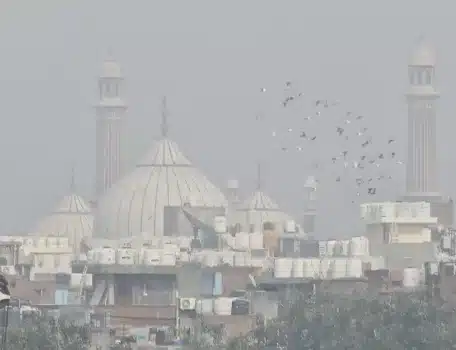
Delhi’s air quality deteriorated sharply on Monday morning, with the national capital recording an average Air Quality Index (AQI) of 310 at 8.05 am, pushing it into the ‘very poor’ category for the first time this season.
A thick layer of haze covered several parts of the city as the brief improvement brought by last week’s rainfall faded away. The deterioration comes less than a week before Diwali, raising concerns over how pollution levels could evolve in the coming days.
Jahangirpuri AQI Hits ‘Severe’ Level
Pollution levels were considerably worse in several parts of Delhi.
According to Central Pollution Control Board data, Jahangirpuri recorded an AQI of 420, placing it in the ‘severe’ category.
Rohini and Punjabi Bagh reported AQI readings of 399 each, just below the severe threshold.
Other heavily polluted areas included:
- Alipur — 382
- Mundka — 377
- Vivek Vihar — 376
- Narela — 375
- RK Puram — 370
- Sonia Vihar — 370
- Bawana — 365
- ITO — 351
Of the 58 monitoring stations for which data was available, Tikri Kalan recorded the lowest AQI at 160, followed by Ghummanhera at 186 and Maidan Garhi at 189.
Sharp Deterioration Within 24 Hours
Delhi’s air quality had been considerably better a day earlier.
At 9 am on Sunday, November 1, the city’s AQI stood at 222, which falls in the ‘poor’ category.
The rise to 310 by Monday morning therefore marked a significant deterioration within about 24 hours.
Under CPCB standards, an AQI of 0-50 is classified as ‘good’, 51-100 as ‘satisfactory’, 101-200 as ‘moderate’, 201-300 as ‘poor’, 301-400 as ‘very poor’ and 401-500 as ‘severe’.
Winter Action Plan Comes Into Force
The spike in pollution coincides with the implementation of Delhi’s Winter Action Plan, which came into force on November 1.
The measures are aimed at reducing pollution from vehicles, construction activity, road dust and traffic congestion during the winter months.
Different restrictions will remain in force for varying periods between November 1 and February 28.
Among the major measures, vehicles registered outside Delhi that do not meet BS-VI emission standards are barred from entering the capital until January 31, subject to specified exemptions.
Authorities are also using Automatic Number Plate Recognition cameras and enforcement teams at border points to identify vehicles violating the restrictions.
₹68.4 Lakh in Penalties on Day One
Delhi authorities imposed ₹68.4 lakh in penalties and environmental compensation on the first day of the Winter Action Plan.
According to official data available till 5 pm on Sunday:
- 14,930 vehicles were checked.
- 1,539 vehicles were turned back at Delhi’s borders.
- 566 challans were issued for PUCC violations.
- ₹56.6 lakh was imposed for PUCC-related violations.
- ₹2 lakh was imposed for breaches of vehicle-entry restrictions.
- ₹9.8 lakh was levied as environmental compensation for construction and demolition violations.
Authorities also inspected 300 construction sites, finding violations at 32 locations.
Pre-BS-VI Vehicles Face Entry Restrictions
As part of the new restrictions, Delhi Traffic Police and Transport Department teams are checking vehicles entering the capital from neighbouring states.
Of the nearly 15,000 vehicles inspected on the first day, about 10 per cent were turned back.
CNG vehicles, electric vehicles and vehicles engaged in specified essential services are exempt from the entry restrictions.
Parking charges at authorised parking facilities have also been doubled until February 28 as part of efforts to discourage private vehicle use.
Government and private offices have additionally been directed to limit physical attendance to 50 per cent during part of the winter period, with exemptions for essential and emergency services.
GRAP Stage 1 Already in Force
The Commission for Air Quality Management had invoked Stage 1 of the Graded Response Action Plan (GRAP) across Delhi-NCR on October 21 after pollution levels slipped into the ‘poor’ category.
Stage 1 measures include stricter control of construction dust, mechanical sweeping of roads, enforcement against visibly polluting vehicles and measures to reduce open waste burning.
The latest jump into the ‘very poor’ category could lead authorities to closely monitor whether further GRAP restrictions become necessary if pollution worsens.
Diwali Adds to Pollution Concerns
The deterioration has come just days before Diwali, traditionally a period when Delhi’s air quality faces additional pressure from firecrackers, weather conditions, vehicular emissions and other pollution sources.
The Supreme Court is also currently examining regulations governing firecracker use and enforcement in Delhi-NCR.
With Delhi already entering the ‘very poor’ category before Diwali, authorities are likely to intensify monitoring and enforcement in the coming days as winter conditions begin to trap pollutants closer to the ground.
