
As coronavirus quickly spreads around the world, it’s forcing people to stay put, and wreaking havoc on the economy. Millions are either out of a job or working from home. Factories are shuttering, and with mandates to stay inside becoming the new norm, people aren’t driving or flying.
All this has led to an enormous decline in air pollution, which kills a total of 4.2 million people every year, and over 1 million in China alone. The last two months have seen a huge uptick in air quality, especially in hard-hit areas like Wuhan and Northern Italy, as well as a number of metropolitan areas throughout the U.S.
While experts caution against viewing these numbers as a cost-benefit calculation around pandemics, some climate scientists hope that they will help shed a light on the massive environmental impact of our everyday habits and economic activities, potentially leading to some positive change after the crisis subsides.
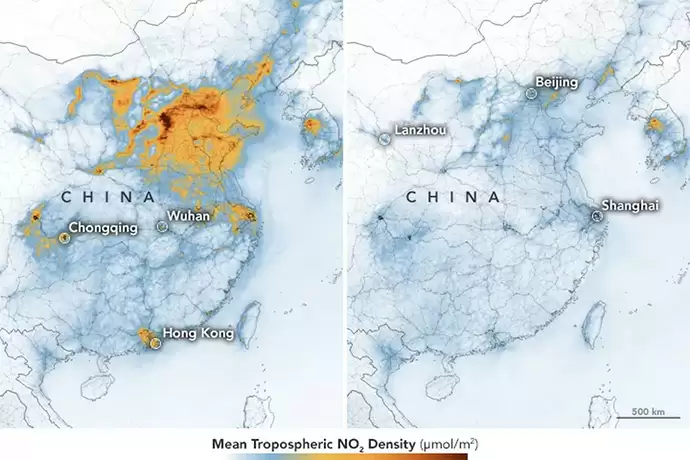
New maps using data collected from NASA and European Space Agency satellites show how nitrogen dioxide, a dangerous gas released by burning fuel, has dissipated since the outbreak.
Maps depicting nitrogen dioxide levels in Wuhan, China from January 1st through February 25th of last year show the region blanketed in fiery colors, with parts in a deeper red signifying high concentrations of the pollutant. Fast forward to this year, and maps of the same region show a stark difference: they’re nearly all blue, showing lower concentrations.
:no_upscale()/cdn.vox-cdn.com/uploads/chorus_asset/file/19760589/wuhan_trop_2020056.png)
Even though pollution typically drops during that time period as the country celebrates the Lunar New Year, scientists say what they’re seeing this year is a stark difference. “This is the first time I have seen such a dramatic drop-off over such a wide area for a specific event,” Fei Liu, an air quality researcher at NASA’s Goddard Space Flight Center, said in a statement. The steep fall in emissions happened more rapidly than what she observed during the 2008 economic recession, and is also lingering longer than the drop in pollution in Beijing during the Olympics that year. “I am not surprised because many cities nationwide have taken measures to minimize spread of the virus,” Liu said.
