
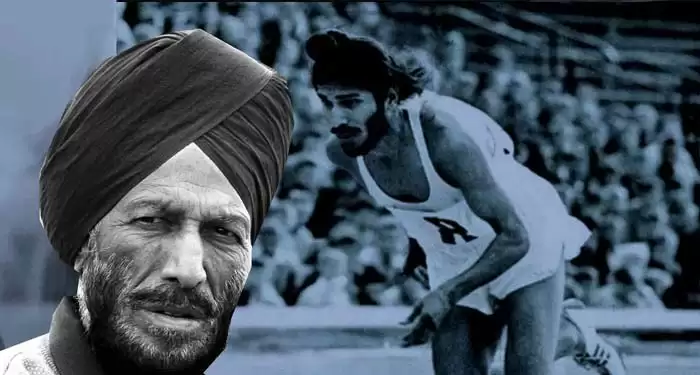
New Delhi: The life of Milkha Singh was like an open book like a running track, reading which many people of the country found the meaning and purpose of their life. Even though 91-year-old Milkha’s body succumbed to COVID-19 on Friday after fighting for a month, Milkha had won battles that many people could not even fight before.
Milkha was one of the biggest sports icons of independent India. He was tormented from within by what he had to suffer in the early stages of his life. He witnessed the brutal murder of his parents during the partition. He also indulged in petty crimes to survive in the refugee camps of Delhi, which led to jail time and three failed attempts to join the army.
Who could have imagined that such a man would get the title of ‘The Flying Sikh’? But Milkha got it.
He treated the track with the same respect as the deity is worshiped in a temple. Running for him was like both his god and girlfriend, and from this he weaved the real story that sounds as wonderful as the fairy tale in the book.
Speaking of medals, the legendary athlete was a four-time Asian Games gold medalist and 1958 Commonwealth Games champion, but his greatest performance was a fourth-place finish in the 400m final of the 1960 Rome Olympics. He missed out on winning the medal by a narrow margin.
Milkha’s real contribution is much bigger than getting the medal. He stunned Indian athletics on the global stage when he won gold in the then 400 meters race of the 1958 British and Commonwealth Games.
He became the first Indian athlete to win an individual gold at the Commonwealth Games, leading the then Prime Minister Jawaharlal Nehru to declare a national holiday at his request. Milkha set his career record with 77 wins out of 80 races.
Milkha Singh’s Race of Life will remain the Rome Olympics where she finished the 400m final in 45.6 seconds, 0.1 seconds short of the bronze medal mark. Milkha Singh regretted all his life that if he had taken the right decisions then the country would have got a medal. Hard to believe but he failed to gauge his conditions and slowed down a bit as he was aiming to unleash full energy in the last 150 metres. He was tormented by that memory, saying that he could not forget only two incidents in his life, the murder of his parents in Pakistan and the defeat in Rome Olympics by a minor mistake.
Milkha wrote in his 160-page autobiography, “The one medal I had been longing for in my entire career had slipped through my fingers.”
