
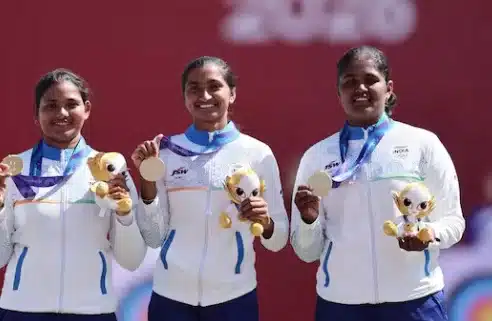
India’s women’s recurve archery team created history at the Asian Games 2026 on Friday, defeating world champions South Korea 5-3 in a thrilling final to claim the country’s first-ever gold medal in the event.
The Indian trio of Ankita Bhakat, Kirti Sharma and Kumkum Anil Mohod showed remarkable composure under pressure to overcome the formidable Korean team of Kang Chaeyoung, Lee Yunji and Oh Yejin.
India had never previously reached the women’s recurve team final at the Asian Games. South Korea, meanwhile, had won the event at every Asian Games since 1998 and was chasing an eighth consecutive title.
India Beat China 5-1 to Reach Historic Final
India booked its place in the gold-medal contest with an impressive 5-1 victory over China in the semi-final.
Despite challenging conditions in Nagoya, Ankita, Kirti and Kumkum worked well as a unit and repeatedly delivered strong arrows at crucial moments.
Kirti played an important role in the semi-final, producing 10s with the last arrows of the opening two sets. India then did enough in the final set to seal its passage to a maiden Asian Games final in the event.
The achievement was already historic, but the Indian archers were not content with silver.
First Two Sets Tied Against World Champions
South Korea entered the final as the established powerhouse of women’s recurve archery, but India matched the defending champions from the outset.
The opening set ended 54-54, giving both teams one set point.
South Korea raised its score to 56 in the second set, but India again matched it with 56, leaving the final tied at 2-2 after two sets.
Kumkum was particularly impressive under pressure, producing important 10s to ensure India stayed level with the Koreans.
India Take Control in Third Set
The turning point came in the third set.
Kirti opened with a 10 before Ankita and Kumkum added two 9s. South Korea struggled in the second half of the set, including a series of 8s.
India finished with 55 points against Korea’s 51, taking the set and moving into a 4-2 lead.
That left India needing only a draw in the fourth set to secure the gold medal.
Dramatic Review Helps Seal Gold
South Korea responded strongly in the fourth set and posted 54 points, putting the pressure firmly on the Indian trio.
India then needed to match that score to win the contest without a shoot-off.
Kirti’s first arrow was initially marked as an 8 before being upgraded to a 9 following a review. With the gold medal on the line, India eventually reached 54 to tie the set.
The 54-54 draw gave both teams one point, taking the overall score to 5-3 in India’s favour and confirming a historic gold medal.
From Bamboo Bow to Asian Games Champion: Kumkum’s Remarkable Rise
The gold medal also capped remarkable individual journeys for all three Indian archers.
Kumkum Mohod only switched to recurve archery around three years ago. She had begun her journey in the sport using the traditional method with a bamboo bow before progressing rapidly to the international level.
Kirti Sharma, meanwhile, had reportedly once been considered too thin to handle the physical demands of a recurve bow.
Ankita Bhakat brought considerably more international experience to the team. She was part of the Indian women’s recurve side that won bronze at the previous Asian Games in Hangzhou and entered the Nagoya Games with 23 international medals to her name.
India End South Korea’s Long-Running Asian Games Streak
The victory represents a major breakthrough for Indian recurve archery.
South Korea had won seven consecutive women’s recurve team gold medals since 1998, and India had never even competed in the final before Friday.
Ankita, Kirti and Kumkum changed that history in Nagoya, matching the world champions under pressure before taking advantage when the Koreans faltered.
The 5-3 victory gave India its maiden Asian Games women’s recurve team title and brought an end to one of South Korea’s longest-running winning streaks at the continental event.
For Indian recurve archery, the result is a significant milestone, showing that the women’s team can compete with and defeat the strongest teams in the world on the biggest continental stage.
