
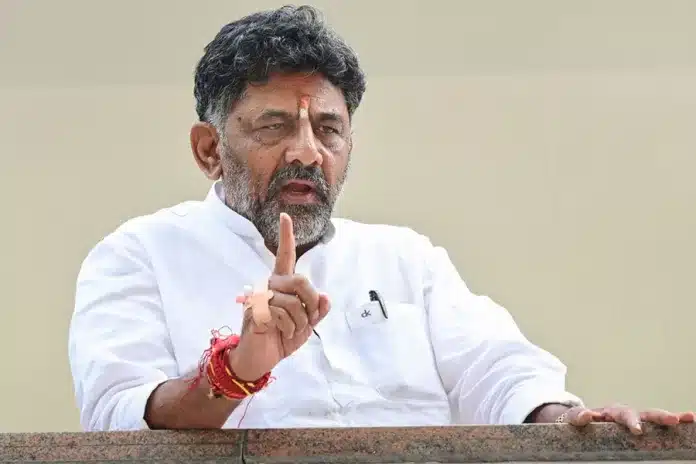
For the first time since DK Shivakumar took over as Karnataka Chief Minister, the state Cabinet is set to meet in coastal Karnataka, a region that has remained one of the Bharatiya Janata Party’s strongest electoral territories for decades.
The Shivakumar-led government will hold its Cabinet meeting in Mangaluru on September 18, with departments asked to identify proposals concerning coastal Karnataka for consideration. The move comes as the government completes 100 days in office.
Officially, the meeting is focused on administration and development. Politically, however, its location is significant as Karnataka’s parties begin looking ahead to the 2028 Assembly election.
Mangaluru is not just the headquarters of Dakshina Kannada. It lies at the centre of a coastal region where the BJP and the Rashtriya Swayamsevak Sangh (RSS) have built a powerful political and organisational presence over several decades.
Dakshina Kannada and neighbouring Udupi have frequently been described in political discourse as a Hindutva stronghold because of the long-standing grassroots presence of the RSS and its affiliates.
Taking the Cabinet to Mangaluru, therefore, gives Shivakumar an opportunity to put his government’s development agenda directly before voters in one of the BJP’s most reliable regions.
BJP Won 11 of 13 Coastal Seats in 2023
The electoral numbers underline the scale of the challenge facing the Congress.
Udupi was carved out of the erstwhile Dakshina Kannada district in 1997. Today, Dakshina Kannada has eight Assembly constituencies, while Udupi has five.
In the 2023 Karnataka Assembly election, the BJP won all five seats in Udupi and six of the eight seats in Dakshina Kannada. The Congress managed to win just two seats across the two districts.
That gave the BJP 11 of the region’s 13 Assembly seats, even as the Congress swept to power statewide with 135 seats.
The coast has largely remained favourable to the BJP for nearly three decades, though the Congress managed a major breakthrough in the region in the 2013 election.
For Shivakumar, reducing the BJP’s dominance here could therefore become an important part of the Congress’s strategy for 2028.
Why Coastal Karnataka Matters to DKS
The Congress’s 2023 victory was built on a broad social coalition, with Siddaramaiah and the party’s AHINDA politics playing an important role.
AHINDA refers to a political coalition centred on minorities, backward classes and Dalits.
But Karnataka’s political equations have changed following Siddaramaiah’s exit from the Chief Minister’s office and his renewed engagement with social justice and AHINDA politics.
For Shivakumar, the challenge ahead of 2028 is not merely to reproduce the Congress’s 2023 performance. He also needs to expand the party’s support into areas where it has traditionally struggled.
Coastal Karnataka offers one such opportunity.
“BJP has a stronghold in Dakshina Kannada and Udupi for around 30 years. The upcoming Cabinet meeting in Mangaluru is one step DKS is taking to appeal to voters in a region that has consistently chosen the BJP,” Bengaluru-based senior journalist and Asianet Suvarna News Political Editor Prashanth Natu told India Today Digital.
According to Natu, Shivakumar is looking to bring down the BJP’s seat tally in 2028 by targeting constituencies that have traditionally been part of its coastal stronghold.
Lingayat Outreach and Coastal Hindutva Vote
Shivakumar’s wider political strategy could involve challenging the BJP on more than one front.
In central and northern Karnataka, sections of the Lingayat electorate have historically been an important pillar of the BJP’s support, particularly under former Chief Minister BS Yediyurappa.
On the coast, the challenge is different.
The BJP’s strength in Dakshina Kannada and Udupi is closely linked to Hindutva politics, grassroots organisations and an established local political network.
“On one end, the Congress government led by DKS is trying to gain the votes of the Lingayats, who traditionally support the BJP due to the leadership of BS Yediyurappa. On the other hand, DKS is trying to hunt the BJP’s Hindutva votes of Dakshina Kannada,” Natu said.
For the Congress, success may not necessarily mean turning coastal Karnataka into a party stronghold.
Even making some of the BJP’s safest constituencies more competitive — and winning a handful of additional seats — could alter the electoral arithmetic in 2028.
Development Could Be DKS’s Coastal Pitch
Shivakumar’s government appears to be placing development at the centre of its engagement with coastal Karnataka.
Departments have been instructed to identify proposals concerning the region ahead of the September 18 Cabinet meeting, while local stakeholders have raised demands relating to infrastructure, tourism, healthcare, education and employment.
Tourism is emerging as one of the major areas of focus.
The Karnataka Tourism Department has outlined a Rs 1,260-crore coastal tourism roadmap under the “Brand Karavali” vision, involving projects across Dakshina Kannada, Udupi and Uttara Kannada.
The government has also discussed connectivity, tourism infrastructure and investment as part of plans to develop Karnataka’s 320-km coastline.
For a region where political debate has long been shaped heavily by ideology and identity, the Congress could attempt to create an alternative conversation around jobs, tourism, infrastructure and economic opportunities.
Can Congress Breach BJP’s Coastal Fortress?
That remains the bigger question.
The BJP’s dominance in coastal Karnataka is not simply the result of a single election cycle or short-term anti-incumbency. Its organisational strength has developed over decades through political, ideological and social networks.
Natu, however, believes Shivakumar’s concentrated attention on the region could offer the Congress an opening.
“Being a highly polarised region electorally, no political party leader has concentrated on Dakshina Kannada like DKS. This might help Congress gain some ground in the region and there is also a 2013 precedence,” he said.
The September 18 Cabinet meeting could therefore serve as an early test of Shivakumar’s coastal strategy.
The Congress has little reason to assume that the electoral coalition that gave it 135 seats in 2023 will automatically remain intact in 2028. Changes around Siddaramaiah and the renewed focus on AHINDA politics mean Shivakumar will also have to build a political coalition associated with his own leadership.
Coastal Karnataka presents one possible avenue for expansion.
The Mangaluru Cabinet meeting is therefore more than an administrative gathering outside Bengaluru. It puts the Shivakumar government directly in a region where the Congress has struggled electorally and where the BJP remains deeply entrenched.
Whether development-led outreach can translate into votes will only become clear in 2028. For now, Shivakumar is signalling that the BJP’s coastal fortress will be part of the electoral battle he intends to contest.
