
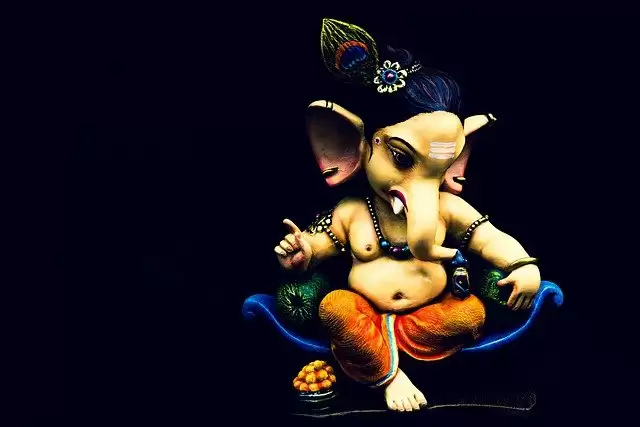
According to Hindu tradition, Ganesh Chaturthi commemorates the birth of Lord Ganesha, the God of Wisdom and Prosperity. Ganesh Chaturthi, one of India’s most important and auspicious holidays, will take place on Friday, September 10 this year, and will last for 11 days, ending on September 21.
Birth
Ganesha, the son of Lord Shiva and Goddess Parvati, has a unique origin tale. Lord Shiva wasn’t present to defend the entrance for Goddess Parvati when she went to take a bath one day. She created a structure out of the turmeric paste she used to scrub her body and breathed life into it because there was no one else. Ganesha was born as a result of this.
The Story of Tusk
Ganesha is also known as ‘Ekdant,‘ which means ‘one tooth,’ in Sanskrit. There are two sides to this storey. According to legend, he lost one of his tusks in a struggle with the sage 7. While guarding the entrance, the sage was enraged with Ganesha for not meeting Lord Shiva.
According to another tale, when Ved Vyas (the Mahabharata’s author) asked Ganesha to write down the Mahabharata for him, he consented on the condition that Vyas tell it all at once, without pausing. The quill he was using broke down as he began writing the narrative, so he cut off one of his tusks and turned it into a pen to continue writing.
Read also: Shilpa Rao recalls Ganesh Chaturthi celebrations with grandma
Story Behind Elephant Head
Ganesha didn’t always have an elephant head; he used to have a regular human head. When Goddess Parvati went to take a bath one day, she instructed Ganesha to guard the entrance, and he was so devoted that he even blocked Lord Shiva from entering.
Ganesha had no idea who Lord Shiva was at the moment. Lord Shiva was likewise unaware of Ganesha’s identity and became enraged, eventually killing him. When Parvati emerged, she screamed at Lord Shiva, threatening to destroy the cosmos unless he brought back Ganesha.
Shiva realised his error and dispatched his warriors into the jungle to capture the head of the first animal they encountered. When the army came upon an elephant, they took his head and put it over Ganesha’s body. As a result, Ganesha became known as the elephant-headed deity, the son of Lord Shiva and Goddess Parvati.
Lord Ganesha and Lord Kartikeya Relationship
Ganesha’s most famous narrative is about winning a tournament against his younger brother Karthikeya in the most straightforward way possible. Both youngsters were given three rounds worldwide to complete, with the winner receiving a unique fruit of wisdom and understanding.
Karthikeya immediately mounted his peacock and flew away, but Ganesha made the prudent decision to ask his parents for permission to revolve about them because they were his world. As a result, Ganesha received the fruit.
Why is Ganesha Called the First God?
According to Hindu custom, Ganesha, the Hindu God of Beginnings, is always prayed to before commencing any auspicious endeavour. This is why: Ganesha was irritated because he was not invited to Lord Vishnu‘s wedding and was referred to as obese. On the route from where the wedding procession was to pass, he dispatched his army of mice to excavate the earth from the inside out and hollow it out.
The army of mice dug up the earth, causing the chariot’s wheels to become stuck. The gods were unable to draw the chariot out on their own, so they enlisted the assistance of a bystander. The wheels came out when he spoke Lord Ganesha’s name! When the gods questioned him about it, he explained that he is the God of Beginnings, who eliminates all obstacles from life. The gods returned after hearing this, apologised to Ganesha, and invited him to the wedding.
Read also: States observe Ganesh Chaturthi; CMs greet people
Legacy Behind the Tradition
Devotees carry icons of the god to their houses and worship them to begin the auspicious festival. While the idols are decorated with red sandalwood paste and yellow and red flowers, Vedic chants from religious literature are performed.
Coconut, jaggery, and 21 modaks are then presented to the idol. Families eat delicious food, rejoice with friends and family, worship the idol with passion, and submerge the idols at the end of the remembrance, symbolising Ganesha’s trip to Mount Kailash, the abode of his parents Lord Shiva and Goddess Durga.
When Maratha king Shivaji utilised Ganesh Chaturthi to stir nationalist feelings among his followers battling the Mughals, it became a public commemoration. When the British outlawed political gatherings in 1893, Bal Gangadhar Tilak resurrected the celebration.
Although the event is celebrated throughout India, it is particularly well-known in Karnataka, Maharashtra, and Gujarat. People clean their home temples, offer durva ghas, laddoos, and modaks to the Lord, and end the devotion with an aarti on this day.
The idols are submerged in water sources like rivers, lakes, and oceans after three, five, seven, or ten days of the celebration. The immersion of idols symbolises Ganesha’s return to Mount Kailash. Over 1.5 lakh idols are submerged each year in Mumbai, where the event is celebrated with great pomp.
Ganeshotsav was popularised in the late nineteenth century when independence warrior Bal Gangadhar Tilak decided to hold magnificent pandals in Pune in 1893. At the same time, Ganesh Chaturthi is celebrated throughout India. The Hindu population also observes the event in various areas of the world and neighbouring Nepal.
