

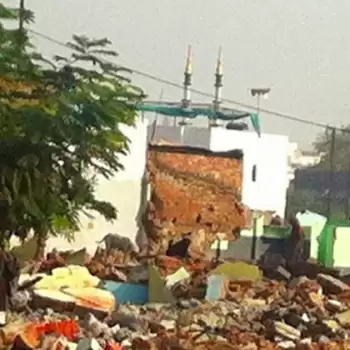
On Wednesday, the Supreme Court extended an interim order instructing authorities to maintain the status quo on the destruction of 5,000 ‘jhuggis’ in Gujarat for a railway line project until September 1. After the petition was brought before it for urgent listing, a bench led by Chief Justice N V Ramana ordered the status quo to be maintained till August 25.
On Wednesday, the case was heard by a bench consisting of Justices A M Khanwilkar and Sanjiv Khanna. KM Nataraj, the Additional Solicitor General, told the court that he is seeking instructions from the authorities and that the case may be heard in two days. In the meantime, he added, the interim order issued in the case may be followed. Tushar Mehta, the Solicitor General, who also testified in the case, said he was making the same plea.
List the case on September 1 as requested by the Solicitor General, the bench said, adding that an interim order will be in effect until then. Senior attorney Colin Gonsalves, representing the petitioner, requested an urgent hearing yesterday, telling the Supreme Court that the authorities planned to begin demolition work on Tuesday, per the Gujarat High Court’s August 19 ruling expel over 10,000 slum inhabitants.
Read also: Supreme Court pulls up Centre for failing to make appointments to Tribunals
While maintaining the status quo, the bench instructed that an appropriate bench hear the case on Wednesday. The high court had overturned its July 23, 2014, interim status quo order, allowing Western Railways to proceed with the Surat-Udhna up to Jalgaon third Railway line project, Gonsalves had told the bench.
The plea, filed by Surat-based ‘Utran se Besthan Railway Jhopadpatti Vikas Mandal,’ claims that if slum dwellers residing on Railway land are not provided with alternate arrangements, irreparable harm will be caused to them and that once they are evicted and made homeless, their situation will become even worse, especially during the COVID-19 pandemic. The appeal, filed by attorney Satya Mitra, asks for a stay on the destruction of these jhuggis, saying that the slum residents have been allowed no breathing time and are being forced to evacuate within 24 hours.
It has also requested that the authorities, including the Centre and the Gujarat government, rehabilitate the slum residents in question. It has asked that the Gujarat government issue a directive to the Gujarat government to rehabilitate all of the households that the Western Railways intends to evict under the current state rehabilitation plan within a specific time limit. It stated that the Western Railways be instructed to develop a rehabilitation programme for the prospective site’s slum inhabitants within a particular period.
It has also attempted to deem Gujarat’s slum rehabilitation policy discriminatory, arbitrary, and unconstitutional, arguing that it excludes slum residents living on railway property. The impugned decision, dated August 19, 2021, violates several Supreme Court of India rulings. According to the appeal, the court has stressed the rehabilitation of slum residents and has held the Right to Housing as an essential component of Article 21 of the Constitution of India. It claimed that the demolition order, which did not include a rehabilitation plan for over 10,000 slum inhabitants, was unlawful, inhumane, and violated Article 21 of the Constitution (protection of life and personal liberty).
Read also: Petition at Supreme Court to Resume Physical School Classes
They’ve been living on railway property for almost 60 years. The majority of them have documentation of residency. The majority of residents have their voter ID cards and ration cards with them as evidence of identity. There are 21 slum communities between Utran and Besthan that will be destroyed, according to the report. According to the petition, the high court stated in an order issued in March 2016 that the destruction of slum residents could not be permitted until the Railway Administration devised a proper and efficient slum dweller rehabilitation programme.
Since 2016, the High Court has requested that the Western Railway provide a restoration plan for the property. Even after five years, the Railway officials had not come up with a restoration plan for the same. Slum residents whose jhuggis are on municipal corporation land are eligible for rehabilitation and are protected against eviction without repair, according to the Gujarat Slum Rehabilitation Policy, 2013, while those whose jhuggis are on railway land are not.
