
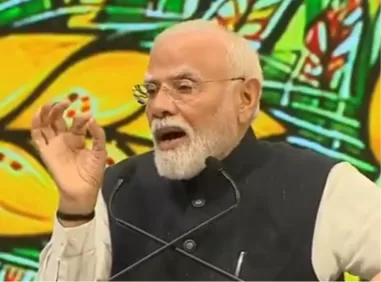
Prime Minister Narendra Modi on Thursday said the government absorbed Rs 43 per litre of a potential Rs 50 increase in diesel prices as crude oil costs surged during the West Asia conflict, limiting the actual increase passed on to consumers to Rs 7 per litre.
Addressing the Kisan Tak Bharat Agriculture Conference 2026 at Bharat Mandapam in New Delhi, Modi said the decision was taken to protect farmers and other consumers from the impact of volatility in global energy markets.
Crude Oil Jumped From $70 to $122 a Barrel, PM Says
Modi said international crude oil prices rose sharply from around $70 to $122 per barrel within a matter of weeks because of the conflict in Iran and the wider Gulf region.
According to the Prime Minister, the rise created conditions in which India would ordinarily have had to increase diesel prices by at least Rs 50 per litre.
However, he said the government decided against transferring the entire international price shock to consumers.
“The country was compelled to increase diesel prices by at least Rs 50 per litre. However, the government decided that the entire burden of international market shocks would not be passed on to the country’s citizens and farmers,” Modi said.
Diesel Price Raised by Rs 7 Instead of Rs 50
The Prime Minister said the government ultimately allowed diesel prices to increase by only Rs 7 per litre while absorbing the remaining Rs 43.
He contrasted India’s approach with neighbouring countries, where, according to him, fuel prices increased by around 40-50 per cent during the same period.
Modi said the move reflected the government’s priority of shielding farmers from a sudden rise in operating costs, particularly because diesel remains an important input for agricultural machinery, irrigation and transportation.
Government Bearing Rs 14,000 Crore Monthly Burden: Modi
Modi further said the government was currently bearing a financial burden of around Rs 14,000 crore every month because of its decision to limit the increase in diesel prices.
“When the interest of the country’s farmers is paramount and when there is the spirit of Nagrik Devo Bhava, then such sensitive decisions are taken,” he said.
The Rs 14,000 crore figure was presented by the Prime Minister as the cost of shielding consumers from the full impact of higher international fuel prices.
Rs 16 Lakh Crore Spent to Keep Fertilisers Affordable
The Prime Minister also highlighted the government’s fertiliser subsidy policy, saying Rs 16 lakh crore had been spent over the past 12 years to make fertilisers available to farmers at affordable prices.
He argued that keeping input costs under control was essential to ensuring that farming remained economically viable despite fluctuations in global commodity prices.
“Sixteen lakh crore is a very big figure. The budgets of several countries around the world are smaller than this amount,” Modi said during his address.
DAP Worth Rs 5,000 Supplied for Rs 1,300: PM
Citing the difference between global and domestic fertiliser prices, Modi said a bag of Di-Ammonium Phosphate (DAP) that costs around Rs 5,000 in the international market was being supplied to Indian farmers for approximately Rs 1,300.
Similarly, he said a bag of urea costing around Rs 3,000 internationally was being made available to farmers in India for less than Rs 300.
The Prime Minister said the government was absorbing the difference to prevent international price volatility from increasing farmers’ cultivation costs.
‘Farming Should Not Become a Burden on Farmers’
Modi said the government’s broader agricultural policy was focused on ensuring that rising input costs did not make farming financially unsustainable.
He linked affordable fertilisers and fuel with efforts to improve agricultural productivity, modernise farming and increase farmer incomes.
The Prime Minister said agricultural development, smarter farming and farmer empowerment were essential for achieving the government’s vision of a Viksit Bharat.
PM Highlights Growth in Agriculture and Allied Sectors
During the conference, Modi also cited growth in several agriculture-related sectors over the past decade.
He said milk production had increased by nearly 70 per cent, egg production by around 90 per cent and fish production had more than doubled.
Honey production, he said, had increased from around 80,000 tonnes to 1.5 lakh tonnes, while horticulture output had risen from about 280 million tonnes to more than 350 million tonnes.
He also said India’s annual agricultural exports had crossed Rs 4 lakh crore.
Farmers Urged to Diversify Beyond Traditional Crops
The Prime Minister called for greater crop diversification, saying farmers needed to move beyond excessive dependence on traditional crops such as wheat, rice and sugarcane.
He highlighted opportunities in horticulture, fisheries, dairy, honey production, natural farming, agricultural technology and renewable energy.
Modi also referred to the PM-KUSUM scheme, saying nearly 12 lakh solar pumps had been provided and that farmers were increasingly becoming energy producers in addition to food producers.
‘Prosperous Farmers Essential for Viksit Bharat’
Concluding his address, Modi said India’s development goals could not be achieved without strengthening agriculture and improving farmers’ financial position.
He said the government would consider suggestions and solutions emerging from the Kisan Tak Bharat Agriculture Conference and continue working towards modern, profitable and technology-driven agriculture.
The Prime Minister framed the government’s interventions in diesel and fertiliser prices as part of this larger strategy to insulate farmers from global economic shocks while keeping the cost of cultivation under control.
