
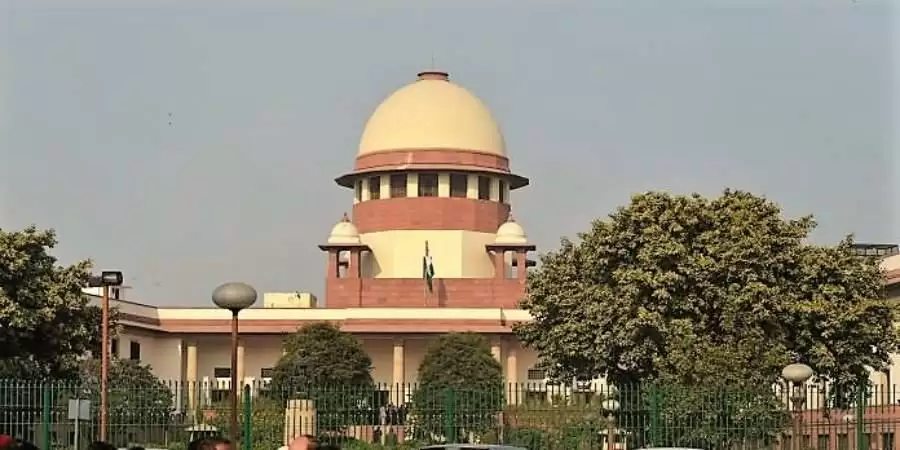

The Supreme Court on Tuesday approved the enlargement of three hill segments in Uttarakhand – Rishikesh to Mana, Rishikesh to Gangotri, and Tanakpur to Pithoragarh – as part of the Chardham Mahamarg Vikas Pariyojna, citing security concerns raised by the Ministry of Defence. According to the Ministry of Road Transport and Highways’ December 5, 2020 circular, this will be in the Double Line-Paved Shoulder (DL-PS) type, with a width of 10 metres (7 metre doubleline roadway and 1.5 metre paved shoulders on either side) (MoRTH).
The bench of Justices D Y Chandrchud, Surya Kant, and Vikram Nath overturned the Supreme Court’s September 8, 2020 judgement, which had instructed the MoRTH to follow its 2018 circular on the width of roads in hilly terrain in the project’s implementation. The highway should be 5.5 metres wide, according to the 2018 rules. The court decided MoRTH and MoD can move on with the project as long as it meets all environmental concerns raised by the court-appointed High-Powered Committee (HPC).
Read also: Free tabs to filling of 24K vacancies: U’Khand CM Dhami on drive to impress voters
The bench also established an Oversight Committee, led by former judge Justice (retired) A K Sikri, to supervise execution of the HPC’s recommendations, noting that the “Project is replete with environmental concerns.” The bench granted the MoD’s appeal to modify the September 2020 decision, saying “at the outset… we conclude that there are no mala fides” in the petition.
“This Court, in exercising judicial review, cannot second-guess the Armed Forces’ infrastructural needs,” Justice Chandrchud wrote for the bench. The bench dismissed the argument made by those opposed to further expanding that disaster-resistant roadways of lesser dimensions would better fulfil the Army’s needs. It said “the submission… requires the Court to override the modalities decided upon by the Army and the MoD to safeguard the security of the nation’s borders” and to “interrogate the policy choice of the establishment which is entrusted by law with the defence of the nation,” pointing out that the 2020 circular was issued by MoRTH based on recommendations received from the MoD. “This is not permitted,” it stated.
The bench observed that opponents of the expansion project cited a remark made by the then-Chief of Army Staff in a media interview on September 20, 2019, that present roadways meet the Army’s needs properly. “We do not believe it is essential to rely on a remark made to the media, given the MoD’s consistent position during the HPC’s deliberations and before this Court,” it stated. The Ministry of Defense’s assessment of security concerns may change over time. National security has faced serious challenges in the recent past. The Armed Forces cannot be bound by a declaration made during a press conference in 2019 as if it were a binding edict.”
“The Centre has approached court again, claiming that “there has been a significant change in circumstances, necessitating an upgrading of roads to allow movement of soldiers and equipment to Army installations” on the India-China border, in response to the September 8, 2020 ruling. The MoRTH circulars from 2012 and 2018 did not clearly address the problem of critical border highways, according to the court.
Read also: Char Dham Yatra resumes as weather clears up in U’khand
Although HPC members may have disagreed on the road width, they unanimously agreed on other environmental concerns in the way the project was being conducted by MoRTH, according to the ruling. ” Unfortunately, these issues appear to have taken a backseat as a result of the continuing litigation over the road-width problem. Going ahead, however, such cannot be the case,” the panel stated.
It said that actions taken to address HPC’s concerns are “limited in scope and late in coming” and “do not address critical issues such as muck disposal, which not only impacts the environment directly but also generates challenges for wildlife and water supply.” While military benefits are important, “it is not the only thing at risk in a Project of this magnitude, which was designed to provide a more efficient path for people making the Char Dham pilgrimage.” The environment’s health, as well as the consequences on all people who live in the vicinity, are also at stake, according to the bench.
